Why does therapy help after a miscarriage?
Coping with a miscarriage doesn’t follow a script. It doesn’t end when the world expects it to. Here’s what pregnancy loss actually feels like, how it can affect your mental health, & why therapy helps at any stage.
Sneak peak:
If you’re reading this on your phone at 2 AM, Googling something you wish you didn’t have to Google, you’re in the right place. Let’s slow down for a minute.
Maybe you can’t sleep, or you’re replaying everything. Maybe you’ve convinced yourself it was somehow your fault even though deep down you know it wasn’t. (It wasn’t – we promise.) You feel fine for five minutes and then suddenly you’re crying in the grocery store because someone walked by holding a newborn. Maybe everyone expects you to move on way faster than your heart actually can.
Therapy gives you a place where you don’t have to fake being okay. You don’t have to make other people comfortable. You can say the thoughts that sound irrational out loud without someone hitting you with “Everything happens for a reason” and making you want to punch the air. (We’ve been there. We get it.)
Going to therapy after a loss helps because miscarriage is more than something that happens physically to your body. It can be an emotional whiplash. One day you were choosing wallpaper and the next you are standing in your kitchen with an overnight pad on, with your brain still emotionally committed to a nursery you didn’t get to finish planning.
A good therapist helps you sort through the guilt, the anxiety, the anger, the jealousy, the sadness, all of it. Especially the stuff parents feel bad admitting. Like being angry at pregnancy announcements. Hating pregnant people. Wanting to protect your partner from ever going through this again so you avoid trying again. Or feeling completely disconnected from yourself afterward.
In this article, we’ll discuss what miscarriage grief feels like, why pregnancy loss is misunderstood, how miscarriage can impact mental health, and why therapy can help after a loss.
What miscarriage grief actually feels like
Miscarriage grief doesn’t follow a script. It doesn’t move through tidy stages. It doesn’t arrive on day one and leave by week six.
It might look like:
- crying at the smell of the lotion you used during pregnancy.
- a wave of rage at someone’s pregnancy announcement on Instagram
- not being able to walk past the nursery door, or not being able to stop walking past it
- feeling fine for three weeks, then sobbing in the cereal aisle
- a dread of going to the bathroom, because the bathroom is where it happened
- holding your living child & grieving the one you can’t hold, at the same time
It’s also physical. Your body remembers the cramping, the bleeding, the ultrasound where the room got quiet. Your hormones are crashing. Your milk might come in for a baby who isn’t here. Your sleep might be impacted. Your appetite might disappear or double. You might catch your reflection and not recognize the body looking back. Each physical reminder may open the grief wound back up again.
Then there’s the relational piece. The partner who’s grieving differently than you, or doesn’t seem to be grieving at all. The mother-in-law who said “at least it was early.” The friend who got pregnant the same month as you and is now showing up to your group chat with ultrasound photos. The well-meaning person who said “everything happens for a reason” and is now someone you can’t be in a room with.
Plus, maybe the loneliest part, the version of yourself you’d already started becoming:
- the future you were imagining
- the name you’d been turning over and trying out
- the crib you’d looked at on three different tabs.
That grief, for a person who hadn’t fully arrived yet, is real. Even when no one else can see it.
The science behind miscarriage grief
This emotional rollercoaster is widely recognized in medical guidance on pregnancy loss, where clinicians note that people often experience intense sadness, anxiety, anger, and grief that can come in waves while still trying to function day to day.1
Why pregnancy loss is so often misunderstood
Pregnancy loss exists in a strange cultural pocket. It’s common. Somewhere between 10 to 20% of known pregnancies end in miscarriage. The number is even higher when you include losses that happened before someone knew they were pregnant, often referred to as chemical pregnancies.2 And yet, it’s still treated as something private and best left unspoken.
What that means for you is that you might be grieving a loss that your friends, your boss, your in-laws, your doctor, and sometimes even your partner don’t fully recognize as a loss.
There’s a term for this in grief research: disenfranchised grief.3 It’s grief that doesn’t get the cultural rituals other griefs get. There’s commonly no funeral, no casserole train, no bereavement leave at most jobs, and no one bringing flowers to your door three weeks later to check in. You’re often expected to be back at work, back at the dinner table, back at the baby shower you said yes to before any of this happened.
The disconnect between outward functioning and internal grief is widely recognized in pregnancy loss support resources. Many people continue daily responsibilities while privately experiencing intense emotional distress that others can’t see.
This societal norm rushes your grief. That’s part of why therapy helps. A perinatal therapist doesn’t need you to explain why this loss counts, no matter how long it’s been.
How miscarriage impacts your mental health
Miscarriage is a recognized risk factor for depression, anxiety, & post-traumatic stress. The research on this is consistent: a meaningful percentage of people who experience pregnancy loss develop symptoms that meet criteria for a mental health condition in the months that follow. Many of them carry those symptoms into their next pregnancy if they don’t get support.
A few of the most common mental health symptoms that show up after a miscarriage include:
Depression symptoms
Depression after a pregnancy loss often feels like a weight that doesn’t shift, no matter how much sleep or coffee or movement you throw at it. Postpartum depression after pregnancy loss is real, even if you didn’t carry to term. Your hormones don’t know the difference between a birth and a loss. They crash the same way. On top of the hormonal piece, you’re grieving a specific, named future you were already living and preparing for.
Depression after miscarriage can look like:
- a heaviness in your chest or limbs that doesn’t lift with rest
- crying that comes out of nowhere (in the car, in the shower, in line at Target)
- losing interest in things that used to feel like yours (a hobby, a friend group, a show you were halfway through, sex with your partner)
- trouble getting out of bed, or getting dressed, or getting through a to-do list you used to handle without thinking about it
- hopelessness about the future, especially the parenting future you were already planning
- guilt that loops & loops looking for somewhere to land (“if I’d just rested more,” “if I’d just skipped that trip,” “if I’d just gone in sooner”)
- a flat mood around your living children that scares you, even though you love them as much as you ever did
- a sense that the version of you who was excited about anything is just . . . gone
- thoughts of not wanting to be here or not wanting to wake up in the morning
Anxiety symptoms
Anxiety after the loss of a pregnancy might look different from general worry. Instead, it may show up as hypervigilance about your body or waiting for something wrong to happen to those around you.
Anxiety after miscarriage can look like:
- checking and re-checking for bleeding or spotting, long after the physical recovery is over
- searching pregnancy-loss forums and symptom checkers at 3 AM
- catastrophizing the next pregnancy, or catastrophizing not getting pregnant again
- avoiding pregnant friends, baby aisles, ultrasound photos, baby showers, prenatal appointments to the point where it’s impacting your relationships
- a racing heart in waiting rooms, or before any medical appointment (even if it’s not the OB-GYN)
- replaying the days and weeks before the loss looking for what you missed
- experiencing restlessness, jaw clenching, shallow breathing, that “wired but exhausted” feeling
- difficulty falling or staying asleep, even when you’re depleted
- panic attacks, chest tightness, dizziness, a sense that the room or those around you aren’t quite real
Intrusive or scary thoughts
“Scary thoughts” is the term perinatal clinicians use for the unwanted, often graphic images or thoughts that show up uninvited after a loss.4 They are much more common than people talk about. Having a scary thought is not the same as wanting it, agreeing with it, or being at risk of acting on it.
Intrusive thoughts after a loss may include:
- flashes of what happened in the bathroom, the bed, the ultrasound room, etc.
- intrusive images of what your baby’s body might have looked like
- repetitive “what if” thoughts about your next pregnancy ending the same way
- intrusive images of harm coming to your living children, your partner, your loved ones, or yourself
- thoughts that feel dark or shocking, or not like who you are at all
- a fear that having these thoughts means you’re a bad or unsafe person
Symptoms of PTSD or medical trauma
Pregnancy loss can absolutely be a medically traumatic event. If your loss involved a traumatic ultrasound (the silent room, the tech leaving to “go get the doctor”), an emergency room visit, a D&C or D&E, a hemorrhage, a moment where you thought you might die, or a sense of not being heard by your medical team, there’s a good chance your nervous system is still there experiencing that moment in some way.
Post-traumatic stress disorder after pregnancy loss can look like:
- flashbacks (sudden, vivid re-experiencing of the worst moments)
- nightmares about the loss, the procedure, doctors, babies, or the hospital
- hypervigilance, especially around your body and around medical appointments
- avoidance of pelvic exams, transvaginal ultrasounds, the bathroom where it happened, the hospital, or pregnancy in general
- emotional numbness, or a sense of being disconnected from your body
- feeling jumpy, on edge, or easily startled
- panic at the smell of hand sanitizer, the sound of a Doppler, the look of a particular waiting room, etc.
- shame about your reactions, such as a sense that you “should be over this by now”
The experience of grief
Grief itself isn’t linear, but miscarriage grief is often brought up again and again by “what-if” moments. Grief that’s still here a year later, or five years later, isn’t a sign that something has gone wrong or that there’s anything wrong with you.
How therapy can help after a pregnancy loss
Pregnancy loss can change the way you move through the world. For some people, the grief feels immediate and consuming. For others, it shows up more quietly (or gradually) as anxiety, numbness, irritability, trouble sleeping, difficulty trusting their body, or a sense that they are no longer the same person they were before the loss.
Therapy creates a space where all of that gets to exist without being rushed or explained away.
A lot of people notice that after a miscarriage or pregnancy loss, the support around them fades quickly. Friends stop checking in. Family members try to say comforting things that accidentally hurt more. Medical appointments end, but the emotional aftermath doesn’t. Therapy can become one of the few places where the loss is still allowed to matter.
For some clients, therapy is about processing grief directly. For others, it’s about understanding the ripple effects:
- the anxiety that appears in a future pregnancy
- the fear of getting attached again
- the strain loss can place on relationships
- feelings of guilt, anger, jealousy, or disconnection
- trauma responses connected to medical experiences, bleeding, procedures, or emergency care
- the loneliness of feeling like everyone else moved on before you could
Pregnancy loss can also bring up older wounds unexpectedly. Sometimes it touches earlier experiences with loss, trauma, body shame, infertility, or feeling unsafe in your own body. Therapy helps make sense of those layers rather than treating grief like something you should simply get over.
In practice, therapy after pregnancy loss may include:
- making space to tell the story of what happened at your own pace
- learning ways to regulate the nervous system when grief or anxiety feels physically overwhelming
- processing traumatic parts of the experience through approaches like EMDR or somatic therapy, if appropriate
- preparing emotionally for future pregnancies or fertility treatment
- helping partners communicate when they’re grieving differently
- creating rituals, language, or meaning around a loss that may have felt invisible to others
Most importantly, therapy offers something many people don’t receive after a pregnancy loss: consistent emotional care. Grief this significant was never meant to be carried completely alone.
When to start therapy after a miscarriage
There’s no rule about timing when it comes to starting therapy.
Sometimes, clients start therapy within days of a loss because they know they’re going to need support, or it’s a recurrent pregnancy loss and they want to take care of themselves through it. Occasionally, people reach out when they’re trying to get pregnant again or talking about trying again with their partner. (Non-birthing partners are welcome to attend therapy after a miscarriage, too! Your grief is just as valid.)
Any timeline is okay.
A few signs it might be time to reach out for support include:
- you’re having intrusive or scary thoughts
- you’re replaying the experience over and over
- you’re avoiding anything and everything that reminds you of the pregnancy
- you have difficulty being around babies, pregnancy announcements, or certain dates
- you’re having trouble sleeping or concentrating
- you feel irritable or angry over the situation or towards those around you
- you are emotionally numb disconnected from yourself (or others)
- you’re feeling guilty or blaming yourself for what happened self-blame
- you feel like your body failed you
- you’re using alcohol, food, work, or scrolling to keep the feelings at a distance
- your relationship is straining under the difference between how you and your partner are grieving
- you have living children, and you’re not sure how to be the parent you want to be right now
- you think like you’re supposed to be over it, and you’re not
- you’re terrified to get pregnant again (even though deep down you want to)
- you’re pregnant again and having intense anxiety
What to expect in your first counseling session for pregnancy loss
You don’t need to have your timeline organized, your feelings labeled, or the “right” words for what happened to attend your first therapy session.
Here’s roughly what happens.
If it’s a virtual session, you’ll log on from wherever you are. That might be your couch, your parked car, your bed with the blinds closed, the floor of your living room while your toddler naps.
If it’s an in person session, you’ll arrive and wait in the lobby until your therapist comes out to call your name and introduce themselves.
Your therapist will start by getting a sense of you. Not just the loss. What your life looks like right now. Who’s in your life. What’s been carrying you through, and what’s been heavy or hard. They’ll ask about the loss when you’re ready to talk about it, and they’ll let you tell it however you tell it.
They might ask about your physical recovery. Your sleep. Your eating. Any past losses or fertility history. Your relationships. Your support system. Whether you’re trying again, or thinking about it, or actively avoiding the question.
You don’t have to answer everything. You can say “I’m not ready to talk about that yet.” That’s a complete sentence.
By the end of the first session, you’ll usually have a sense of whether this therapist feels like the right fit. You are always allowed to ask questions to your provider, ask for a different therapist, or seek out someone else. A good therapist will help you find someone who’s a better match. In fact, the relationship between a therapist and a client is a huge factor in treatment, but sometimes it might take a few sessions to get to know one another.5
How to find a therapist for pregnancy loss
Here’s a few things to look for when you’re searching for a therapist to help you after a miscarriage.
Perinatal specialization
Look for therapists who list pregnancy loss, perinatal mental health, or reproductive mental health as a primary specialty. You don’t want “perinatal mental health” to be a bullet point on a long list.
The PMH-C credential (Perinatal Mental Health Certified) is a great thing to look for as it means these therapists have been exclusively trained by Postpartum Support International. Similarly, a practice where every clinician focuses on perinatal work can be helpful to find.
Comfort with the hard parts
A perinatal therapist should be comfortable talking about miscarriage at every gestation, stillbirth, ectopic and molar pregnancies, TFMR, abortion, infertility, & the messy in-between of all of it. If their website only talks about “the joys of new motherhood” or “anxiety for new parents”, they may not be the right fit.
Therapeutic modalities for trauma and loss
Eye Movement Desensitization and Reprocessing therapy (EMDR) is often a fit for the trauma piece of pregnancy loss.6 Somatic and body-based work helps with the grief your nervous system is holding. Since pregnancy loss involves so much of our mind and body, it’s important to include the connection between both in therapy.
Attachment-based and relational work also helps, such as couples work or understanding how this loss is bringing up situations from your past.
Accessibility
Virtual sessions remove a lot of barriers. Childcare, transportation, geography, the energy it takes to put on real pants – they are all part of the puzzle when it comes to making sure you are taking care of your mental health.
Insurance, sliding scale, or transparent private pay rates also matter. If you have questions about what your insurance covers, you can always reach out to a practice and ask for more information.
Miscarriage therapy in Kansas and Missouri
In both Kansas and Missouri, there are therapists who focus specifically on pregnancy loss, infertility-related grief, and postpartum mental health.
One practice that works in this space is Holding New Therapy, which supports people across both states – Kansas and Missouri – navigating pregnancy loss, infertility experiences, and reproductive trauma. The focus there is on this very specific kind of aftermath that doesn’t always look dramatic from the outside but can feel extremely loud inside your own body and mind.
Because miscarriage grief doesn’t always show up in obvious ways. Not every provider is familiar with the emotional layering that follows miscarriage. Some are, and those are the ones that tend to make a difference when everything still feels unsettled internally.
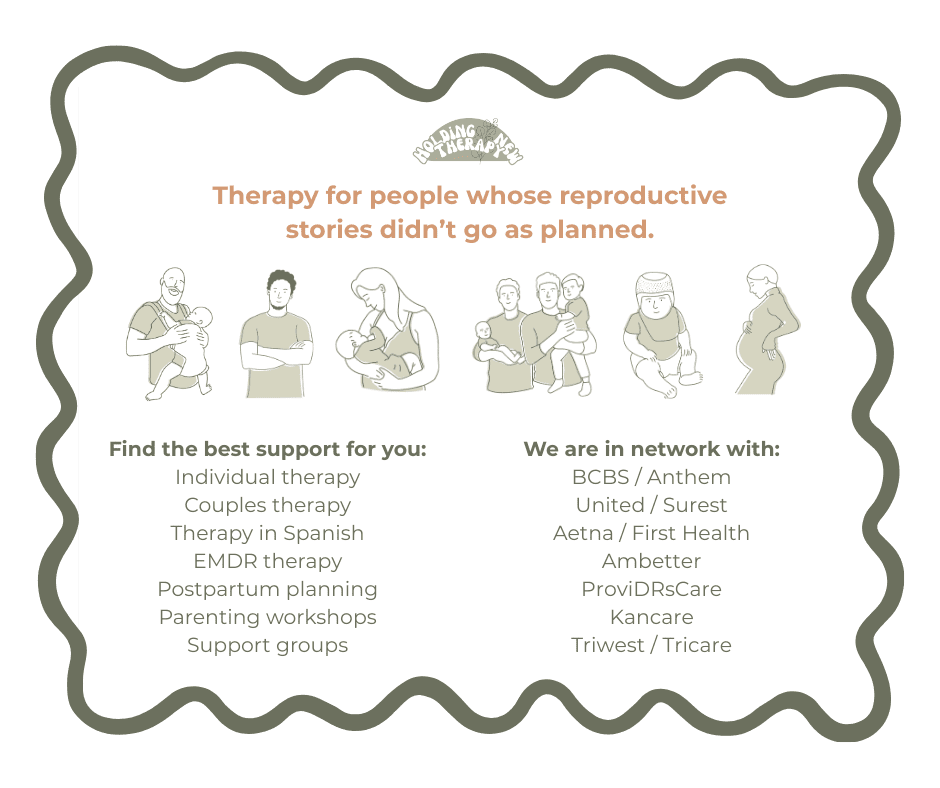
We see clients across Kansas (Wichita, Kansas City, Overland Park, Lawrence, Topeka, Manhattan, Salina, Hutchinson, Hays, Garden City, Dodge City, Pratt, Emporia, Fredonia, and everywhere in between) & across Missouri, all virtually. We accept BCBS/Anthem, Optum/United, Aetna, Ambetter, ProviDRsCare, Kansas Medicaid (Healthy Blue, Sunflower, United Community Health Plan), Medicare, and TriWest/TriCare, with private pay available across the team. Spanish-language therapy is also available.
Starting therapy doesn’t require you to be at a breaking point, in a crisis, or even fully certain about what you need. If you’ve just experienced a pregnancy loss, or if you’re grieving one from the past, our therapists would love to support you.
Takeaway
- Miscarriage grief is real grief, even when the world around you doesn’t fully recognize it that way. Many people are expected to return to daily life quickly while privately carrying anxiety, trauma, anger, sadness, and a future they had already started imagining. The emotional impact of pregnancy loss often lasts far longer than people expect.
- Pregnancy loss can affect your mental health in ways that are both emotional and physical. Depression, anxiety, intrusive thoughts, medical trauma responses, and PTSD symptoms are all common after a miscarriage. Healing rarely follows a predictable timeline.
- Therapy after miscarriage helps because it gives you a place where the loss does not have to be minimized, explained away, or rushed. A perinatal therapist can help you process grief, trauma, guilt, relationship strain, fear around future pregnancies, and the complicated emotions that often feel difficult to admit out loud.
- There is no perfect time to start therapy after a miscarriage. Some people seek support immediately, while others reach out months or years later when grief resurfaces during anniversaries, fertility treatment, or another pregnancy. If the loss still feels heavy, intrusive, isolating, or unresolved, it is still worthy of care. You do not have to wait until you are falling apart to deserve support.
- Finding a therapist with specific training in perinatal mental health is important. Miscarriage carries emotional layers that not every provider is prepared to hold, especially when grief overlaps with trauma, infertility, body changes, or fear of trying again. The right support should feel like a space where you don’t have to convince someone that this loss mattered.
FAQs about miscarriage mental health
Not everyone needs therapy after a miscarriage, but many people benefit from having support during or after pregnancy loss. Miscarriage can impact your mental health, relationships, sleep, sense of safety in your body, and future pregnancy experiences in ways that are hard to carry alone.
A therapist can help you process grief, intrusive thoughts, anxiety, guilt, anger, medical trauma, and the complicated emotions that often follow a loss. Many people find relief in finally being able to talk openly about what happened and how it the miscarriage is still continuing to impact them, no matter how long it’s been.
There is no set timeline for miscarriage grief. Some people feel intense grief for weeks or months, while others notice waves of grief resurfacing years later around anniversaries, future pregnancies, or life milestones.
You can start therapy at any point after a miscarriage. Some people begin therapy immediately after a loss, while others reach out months or years later when anxiety, grief, or trauma symptoms begin interfering with daily life.
If you’re replaying the experience constantly, avoiding reminders of the pregnancy, struggling emotionally in a new pregnancy, or feeling like you’re carrying the loss alone, it may be a good time to seek support.
What helps with miscarriage grief often looks different for every person, but support tends to matter more than “moving on.” Many people benefit from:
- therapy with a perinatal mental health specialist
- support groups for pregnancy loss
- talking openly with trusted people
- nervous system regulation and trauma-informed care
- rest and practical support during physical recovery
- rituals or ways to honor the pregnancy and loss
For many people, the most healing thing is being allowed to grieve without pressure to make the experience smaller or more acceptable to others.
Miscarriage can absolutely be traumatic, especially if the experience involved intense pain, heavy bleeding, emergency care, frightening medical experiences, a D&C or D&E, recurrent losses, or feeling unsupported by providers. Some people develop symptoms of post-traumatic stress after pregnancy loss, including flashbacks, nightmares, panic, hypervigilance, intrusive thoughts, or avoidance of medical settings and future pregnancies.
EMDR (Eye Movement Desensitization and Reprocessing) is one therapy approach that can help people process traumatic aspects of pregnancy loss. It may be especially helpful for flashbacks, intrusive memories, medical trauma, panic, or feeling emotionally “stuck” after a miscarriage. EMDR is often used alongside other forms of perinatal therapy and grief work, depending on your needs and readiness.
Pregnancy loss therapy is counseling specifically focused on the emotional impact of miscarriage, stillbirth, termination for medical reasons, infertility-related grief, ectopic pregnancy, chemical pregnancies or other reproductive losses. A pregnancy loss therapist understands the unique grief, anxiety, trauma, and identity shifts that can happen after losing a pregnancy. Perinatal therapy may include grief support, trauma therapy, relationship support, coping strategies, and preparation for future pregnancies.
When looking for a miscarriage therapist in Kansas or Missouri, it can help to search for providers who specialize in:
- perinatal mental health
- reproductive trauma
- miscarriage counseling
- infertility and pregnancy loss
- EMDR or trauma-informed therapy
Holding New Therapy would love to help support you with our wide range of therapists who specialize in perinatal mental health and reproductive loss. Here’s where you can begin.
Holding New Therapy is a perinatal mental health practice licensed in Kansas & Missouri. Our team specializes exclusively in pregnancy, postpartum, infertility, loss, birth trauma, & the complicated middle of reproductive mental health — including body image & disordered eating during the perinatal period. This post is for informational purposes & is not a substitute for individualized clinical care. If you are in crisis or believe you are at risk of harming yourself, please call or text 988.
References:
- Opland, C. (2024, October 6). Psychotherapy and therapeutic relationship. StatPearls [Internet]. https://www.ncbi.nlm.nih.gov/books/NBK608012/
↩︎ - Mayo Foundation for Medical Education and Research. (2023, September 8). Miscarriage. Mayo Clinic. https://www.mayoclinic.org/diseases-conditions/pregnancy-loss-miscarriage/symptoms-causes/syc-20354298
↩︎ - Cesur-Soysal, G., & Arı, E. (2022). How we disenfranchise grief for self and other: An empirical study. OMEGA – Journal of Death and Dying, 89(2), 530–549. https://doi.org/10.1177/00302228221075203
↩︎ - Maternal Mental Health Alliance. (n.d.). Intrusive thoughts and other scary feelings. Intrusive thoughts and other scary feelings | Maternal Mental Health Alliance. https://maternalmentalhealthalliance.org/about-maternal-mental-health/perinatal-mental-health-symptom-checker/intrusive-thoughts-and-other-scary-feelings/
↩︎ - Opland, C. (2024a, October 6). Psychotherapy and therapeutic relationship. StatPearls [Internet]. https://www.ncbi.nlm.nih.gov/books/NBK608012/
↩︎ - Go with… exactly what she needs: EMDR therapy for Perinatal Mental Health – EMDR International Association. EMDRIA. (n.d.). https://www.emdria.org/blog/go-with-exactly-what-she-needs-emdr-therapy-for-perinatal-mental-health/
↩︎
We’re committed to making therapy for new parents accessible. All of our sessions are held virtually to reduce barriers like transportation, childcare, finances, location, & mobility needs. If there’s anything we can do to better support your access to care (communication preferences, tech accommodations, website adjustments, etc), please let us know at admin@holdingnewtherapy.com.
