Disordered eating in pregnancy: How your relationship with food and body changes
A perinatal therapist on body image shifts, eating disorder relapse, & finding support across Kansas & Missouri.
Sneak peak:
You didn’t expect this part.
You expected the nausea, maybe. The tiredness. Maybe the swollen ankles or the heartburn or the strangers who suddenly feel entitled to your body like it’s a piece of public art.
What you didn’t expect was the food thing. The way breakfast became a negotiation. The way the scale at every prenatal appointment started to feel less like data & more like a verdict. The way you’d catch yourself, hand on your stomach, thinking thoughts you swore you left in college . . . or in treatment . . . or behind you somewhere, anywhere.
And maybe you’ve never had an eating disorder a day in your life, but suddenly your inner monologue around food sounds clinical in a way you don’t recognize.
Or maybe you have — and you’d hoped pregnancy would feel like a clean slate. You’d hoped your body, doing this enormous thing, would finally feel like an ally. Instead, the old voice is back, and it’s louder than it’s been in years.
If any of that lands, you are not the only one. And you are not failing at pregnancy.
In this article, we’ll explore how pregnancy can shift your relationship with food and body, what disordered eating can look like while pregnant, and how to know about the relapse risk for those with a history of eating disorders.
How pregnancy changes your relationship with food
Pregnancy is one of the most rapid physical transformations a human body can undergo. In nine (arguably, 10) months, almost every system — hormonal, cardiovascular, digestive, musculoskeletal — reorganizes itself.1 Your appetite shifts. Your taste buds shift. The shape of you shifts, sometimes faster than your mind can metabolize.
That alone would be a lot. But then layer on:
- weekly weigh-ins where a number is recorded in front of you
- well-meaning comments from family about how you’re “all belly” or “really showing now”
- a healthcare system that still talks about “weight gain goals” with the same flatness as a checklist
- a culture that has spent your entire life telling you smaller is safer & bigger is a problem to solve
It’s not that pregnancy causes disordered eating out of nowhere. Rather, pregnancy hands a megaphone to whatever you were already carrying. The thoughts. The rules. The body shame you’d quietly negotiated a truce with. The trauma you thought you’d outgrown.
For a lot of people, this is the first time a clinician hands them a printout about their body that they can’t fully control. For some, it cracks something open.
Body image during pregnancy (& what helps)
There’s a story you might’ve been told before pregnancy — that growing a baby will finally make you fall in love with your body. It’s doing something miraculous. You’ll feel powerful and full of joy and at peace with the curves you used to fight.
For some people, that happens. For a lot of people, it doesn’t. Sometimes, the gap between how you’re supposed to feel about your pregnant body and how you actually feel can be its own quiet grief.
Maybe you don’t recognize yourself in the mirror. Your face changed (pregnancy nose anyone?!?), or your arms, or your feet — things that had nothing to do with the baby in your uterus. Maybe stretch marks or varicose veins feel like loss instead of bloom. You may feel watched: by your OB, your partner, your in-laws, strangers in the grocery store who think a pregnant body is theirs to comment on.
If you’ve ever lived with body shame, sexual trauma, weight stigma, or a body that didn’t fit cultural narratives of “the ideal,” pregnancy can light all of that back up. Pregnant bodies get inspected, narrated on, and assigned meaning by everyone around them. That’s a lot for any nervous system to hold.
How to improve your body image in pregnancy
What usually helps with pregnancy body image is not what you’ve been told to do. Forcing gratitude doesn’t work. Telling yourself you should love the body growing your baby doesn’t work. The “should” is the problem.
What tends to actually help:
- limiting the mirror and the social media accounts that send you spiraling, without shame about needing to
- wearing clothes that fit the body you have today, not aspirational ones folded in a drawer
- asking your provider for blind weights at prenatal appointments if the scale is destabilizing (you are allowed to ask and you are allowed to tell them not to tell you — turn around on the scale!)
- naming what’s happening out loud to a person who won’t try to fix it or flatten it
- aiming for body neutrality (your body is yours, doing its job) rather than performed body positivity2
Signs of disordered eating during pregnancy
There’s a difference between normal pregnancy adjustment (food aversions, weird cravings, anxiety about gaining “enough” or “too much” for the health of your baby) and something clinical. The line isn’t always obvious, especially when so much of pregnancy is medicalized in ways that already feel intrusive.
Some signs the relationship has shifted into disordered eating during pregnancy:3
- you’re skipping meals or restricting calories on purpose, hoping to stay small
- you’re hiding food behavior from your partner, your OB, your midwife
- you’re using exercise to compensate for what you ate, even when you’re exhausted or in pain
- you’re using movement as a way to punish yourself
- you’re researching how to minimize pregnancy weight gain rather than how to support your body
- you’re avoiding prenatal appointments because of the scale
- you’re bingeing and feeling shame, or purging in any form (including over-exercise, laxatives, or skipping insulin if you’re diabetic)
- the thoughts about your body are louder than the thoughts about your baby
- you feel like you can’t tell anyone how bad it’s gotten
Eating disorder relapse in pregnancy: What to watch for
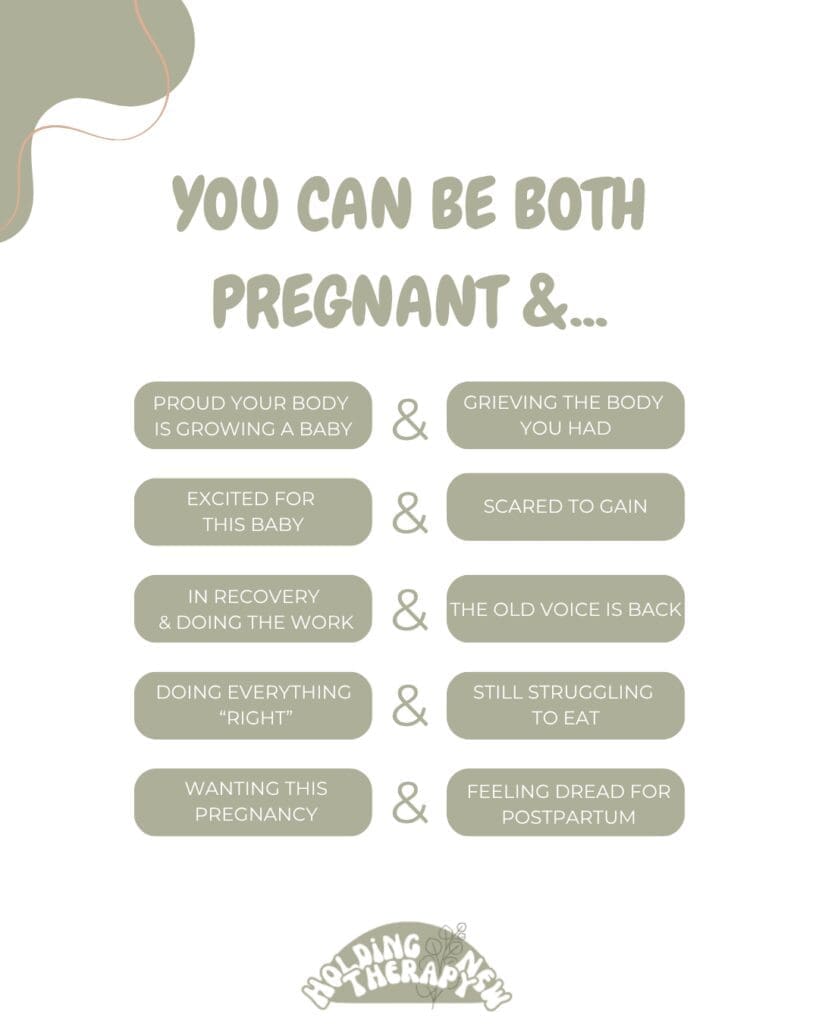
If you’ve been in recovery from anorexia, bulimia, binge eating disorder, OSFED, ARFID, orthorexia, or any disordered eating pattern, pregnancy can be a uniquely high-risk window.
Research consistently shows that perinatal periods are vulnerable times for relapse.4 The body is changing, and the scale is non-negotiable. Old coping behaviors (restriction, over-exercise, control) are often medically dangerous now in ways they weren’t before.
Some of what we see clinically:5
- recovery anorexia slipping back in under the guise of “healthy pregnancy eating”
- binge episodes returning when cravings, hunger cues, and shame collide
- a return of body checking — mirror, waistband, pinching, comparison to other pregnant bodies online
- intrusive thoughts about gaining weight that feel out of proportion to anything you’d say out loud
- a fear of postpartum that’s really a fear of the body that comes after
None of this means you’ve undone your recovery. Recovery is a relationship, and this stage of life is asking new things of it.
Why perinatal eating disorders get missed in standard prenatal care
OBs are doing important work, but they have 15–20 minutes per appointment (often due to insurance) and a checklist of medical risks to monitor. Midwives may have more time per appointment, but there are still signs that could be misinterpreted or missed completely. Disordered eating in pregnancy is frequently under-screened, under-recognized, and under-referred. If your provider doesn’t ask, you may not bring it up.
The intentional therapy time, specialized training, and focused support can work alongside your medical care, to help you.
Therapy for disordered eating in pregnancy: What it actually looks like
At Holding New Therapy, every therapist on our team works exclusively in perinatal mental health. That’s not just a niche we added to a long marketing list.
In fact, several of our therapists, including Lauren Lane, MA, LPC, have additional specialized training in body image work and disordered eating patterns during pregnancy and postpartum.
The work, in practice, often includes:
- understanding your specific history with food, body, & control
- learning to interpret pregnancy body changes through a trauma-responsive and weight-inclusive lens
- building skills to advocate at prenatal appointments (including blind weights, if that’s right for you)
- nervous-system work, not just thought-stopping (because food rules don’t live in the prefrontal cortex and we often need to go further than talk therapy)
- if relevant, EMDR or somatic work for the older roots of the body story
- planning ahead for postpartum, where relapse risk often peaks
- partner sessions when it helps, so you’re not the one carrying the explanation
Perinatal therapy for eating disorders and body image in Kansas & Missouri
There’s a quiet myth in eating disorder culture that you have to be “sick enough” to ask for help. That you have to be in active crisis, hospitalized, or visibly struggling for it to count.
You don’t.
If pregnancy has stirred something up — old patterns, new ones, a sense that the relationship with food or body is starting to slide — that is the moment that deserves you to reach out for support.
We offer perinatal therapy across Kansas and Missouri with virtual services, which means no commute, no waiting room, no childcare logistics if you’re already parenting other little ones. (Plus, in person in Wichita, KS and Lee’s Summit, MO!) You can sit on your couch, or in your car between appointments, or in your bed at 38 weeks pregnant with your dog on your feet.
We work with people in Wichita, Kansas City, Overland Park, Lawrence, Topeka, Manhattan, Salina, Hutchinson, and throughout both states of Kansas and Missouri. We accept most major insurance plans, including BCBS, Aetna, United/Optum, Ambetter, Kansas Medicaid plans, Medicare, and TriCare. Private pay is available, too.
If you’re looking for prenatal therapist support or eating disorder therapy in Kansas City or anywhere across Kansas & Missouri, we’d love to sit alongside you.
Let’s start slowly. You don’t have to have all the words ready.
Takeaway
- Pregnancy changes your body quickly, and that physical shift can also bring old thoughts and patterns about food and body image back to the surface.
- Even if you’ve never had an eating disorder, it’s common for pregnancy to heighten anxiety, control around food, or body preoccupation.
- If you have a history of disordered eating, pregnancy can increase vulnerability to relapse, especially when weight, appetite, and body changes feel harder to control. These experiences are not a sign that you’re doing pregnancy wrong or failing in any way.
- Standard prenatal care doesn’t always catch these shifts, which means your experience may go unnoticed unless you name it.
- Early support from a perinatal-informed therapist can help you stay connected to both your mental health and your physical health during pregnancy and beyond.
FAQs about body image during pregnancy
Disordered eating in pregnancy can look like rigid food rules that feel even more urgent now that your body is changing. It can look like skipping meals and calling it not feeling hungry. It can look like tracking of pregnancy weight gain — down to the ounce — or a dread every time you step on the scale at an OB appointment (that makes you feel shame and guilt).
Eating disorder relapse in pregnancy often because it brings relentless, public, often unsolicited attention to your body — your size, your weight, how you’re eating, how you look. When you add that to hormonal shifts, morning sickness, a changing relationship to food, and the cultural pressure to glow or bounce back, it’s not surprising that a nervous system that has already learned to cope through food or body control might respond to that pressure by reaching for those old strategies. Either way, it is treatable.
Body image during pregnancy can be difficult because the body changes rapidly in ways that may feel unfamiliar, uncomfortable, or outside of a person’s control. Hormonal shifts, physical symptoms, past experiences with body image or eating disorders, and social pressure around pregnancy and postpartum appearance can all contribute to distress. Even in healthy or wanted pregnancies, it’s common to have mixed feelings about body changes.
This question comes with a lot of fear attached to it, and we want to answer it honestly: yes, disordered eating in pregnancy can affect both parent and baby. This is exactly why it deserves real clinical attention.
Nutritional restriction, purging, and extreme food rules can impact fetal development, pregnancy complications, or postpartum recovery.6 But the research also shows that treatment works.7 People who get support during pregnancy have better outcomes than those who don’t.
Perinatal eating disorder therapy is specialized support that holds both the eating disorder and the pregnancy (or postpartum period) at the same time. A perinatal therapist understands that your relationship with food and your body is happening inside a specific reproductive context. A generalist eating disorder therapist may not know how to work alongside your OB, how to address the unique body changes of pregnancy, or how to support you through postpartum without accidentally reinforcing harmful recovery narratives.
It is never too late. The postpartum period brings its own wave of body pressure and sometimes the birth experience itself, or the process of learning to feed a tiny human, will bring up negative patterns around food and body. If you’re struggling now, now is the right time to reach out.
Start by looking specifically for therapists with perinatal mental health training, not just general therapy experience. Credentials like PMH-C (Perinatal Mental Health Certified) indicate specialized training. You are allowed to ask them directly: Do you have experience treating eating disorders during pregnancy? Do you work alongside OBs or perinatal care teams?
At Holding New Therapy, body image and disordered eating in the perinatal period is one of our specialty areas. Lauren Lane, LPC, specializes specifically in this work with our clients. We’re a virtual practice licensed in Kansas & Missouri, which means wherever you are in either state — Wichita, Kansas City, Overland Park, Columbia, Springfield, or anywhere in between — you can access care without having to find someone local.
A few things worth paying attention to:
- Are you spending significant time each day thinking about food, weight, or your body?
- Are you restricting, purging, or using other behaviors to manage anxiety about your size or your baby’s size?
- Is pregnancy weight gain anxiety affecting your ability to eat in ways that feel safe for you and your pregnancy?
- Is the dread constant and not just at appointments, but following you into meals, into mornings, into your relationship?
If any of that sounds familiar, that’s something worth talking to someone about.
Holding New Therapy is a perinatal mental health practice licensed in Kansas & Missouri. Our team specializes exclusively in pregnancy, postpartum, infertility, loss, birth trauma, & the complicated middle of reproductive mental health — including body image & disordered eating during the perinatal period. This post is for informational purposes and is not a substitute for individualized clinical care. If you are in crisis or believe you are at risk of harming yourself, please call or text 988.
References:
- Chandra, M., & Paray, A. A. (2024, March 29). Natural physiological changes during pregnancy. The Yale journal of biology and medicine. https://pmc.ncbi.nlm.nih.gov/articles/PMC10964813/
↩︎ - Smith, A. C., Ahuvia, I., Ito, S., & Schleider, J. L. (2023, August). Project body neutrality: Piloting a digital single-session intervention for adolescent body image and Depression. The International journal of eating disorders. https://pmc.ncbi.nlm.nih.gov/articles/PMC10524309/
↩︎ - Ward, V. B. (2008, January 12). Eating disorders in pregnancy. BMJ (Clinical research ed.). https://pmc.ncbi.nlm.nih.gov/articles/PMC2190274/
↩︎ - Sommerfeldt, B., Skårderud, F., Kvalem, I. L., Gulliksen, K. S., & Holte, A. (2026, May 26). Bodies out of control: Relapse and worsening of eating disorders in pregnancy. Frontiers. https://www.frontiersin.org/journals/psychology/articles/10.3389/fpsyg.2022.986217/full
↩︎ - Pregnancy and eating disorders. National Eating Disorders Association. (2025, November 10). https://www.nationaleatingdisorders.org/pregnancy-and-eating-disorders/
↩︎ - Sebastiani, G., Andreu-Fernández, V., Herranz Barbero, A., Aldecoa-Bilbao, V., Miracle, X., Meler Barrabes, E., Balada Ibañez, A., Astals-Vizcaino, M., Ferrero-Martínez, S., Gómez-Roig, M. D., & García-Algar, O. (2020, September 17). Eating disorders during gestation: Implications for mother’s health, fetal outcomes, and epigenetic changes. Frontiers in pediatrics. https://pmc.ncbi.nlm.nih.gov/articles/PMC7527592/
↩︎ - Policy Center for Maternal Mental Health. (n.d.). Eating disorders and maternal mental health. https://policycentermmh.org/eating-disorders-and-maternal-mental-health/
↩︎
We’re committed to making therapy for new parents accessible. All of our sessions are held virtually to reduce barriers like transportation, childcare, finances, location, & mobility needs. If there’s anything we can do to better support your access to care (communication preferences, tech accommodations, website adjustments, etc), please let us know at admin@holdingnewtherapy.com.
